
- Home
- / Services
- / Corrosion Testing
NACE. ASTM. Electrochemical.
From Lab Qualification to Field Coupons.
Complete corrosion evaluation for oil & gas, petrochemical, power, offshore, automotive, and aerospace — as per ISO 17025:2017 guidelines. ADNOC approved.
Sour Service Testing
H₂S Environment Qualification for Oil & Gas
Full suite of sour service qualification tests per NACE TM0177, TM0284, and ISO 15156. Used by tubular manufacturers, valve OEMs, EPC contractors, and materials certification bodies globally.
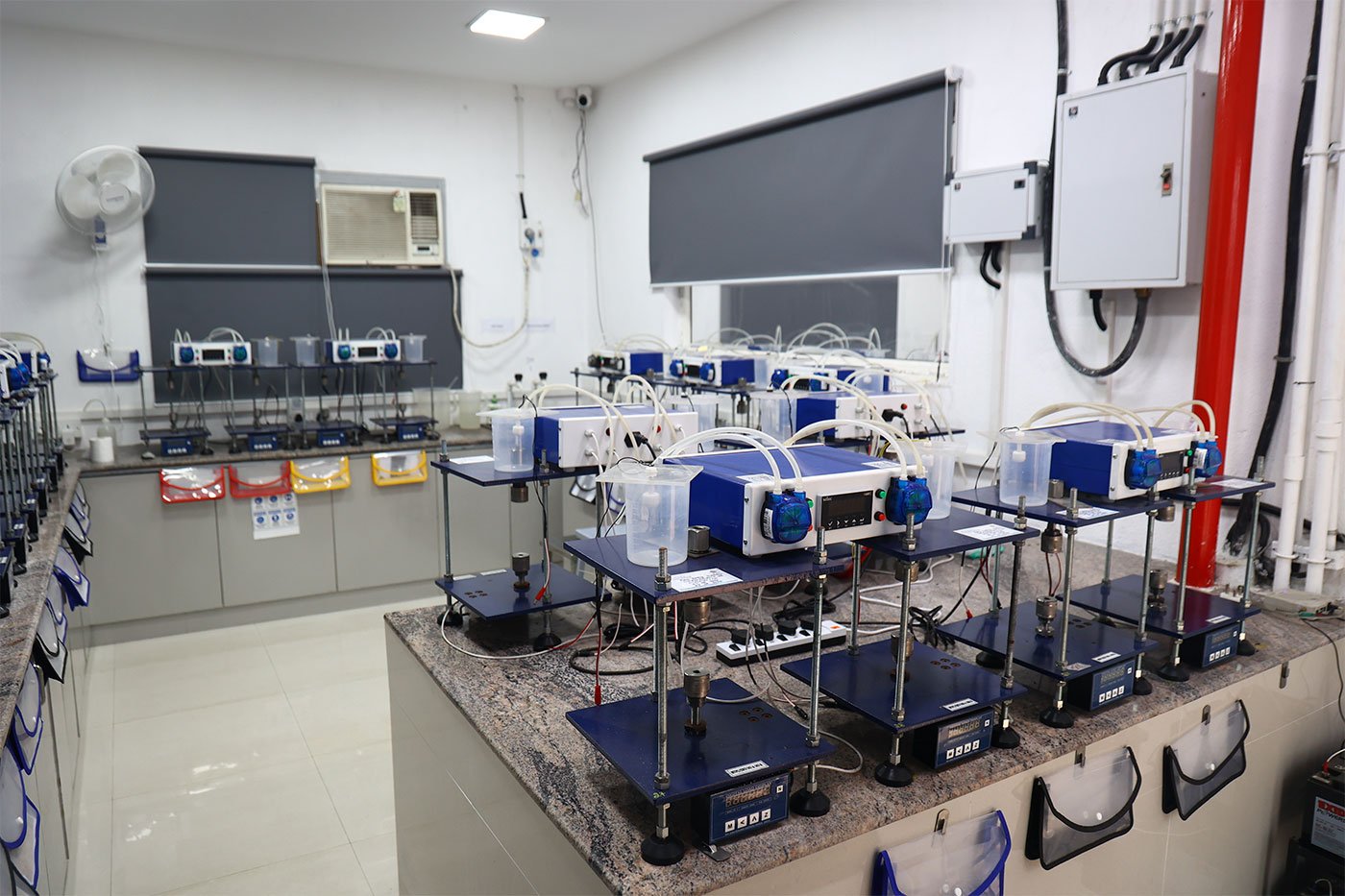
Stress corrosion test setup — multiple cell stations
SSCC — NACE TM0177
Sulphide stress corrosion cracking in H₂S-containing environments. Four methods covering the full range of specimen geometry and loading mode.
- Method A — Tensile
- Method B — Bent Beam
- Method C — C-Ring
- Method D — DCB
HIC — NACE TM0284
Hydrogen induced cracking evaluation for linepipe steels, pressure vessel plates, and sour service components.
- CLR — Crack Length Ratio
- CTR — Crack Thickness Ratio
- CSR — Crack Sensitivity Ratio
SSC 4-Point Bend
Four-point bend test for corrosion-resistant alloys (CRAs) and duplex stainless steels under constant deflection in sour environments. Preferred method when specimen dimensions preclude tensile or C-ring geometry.
- Duplex SS
- Super Duplex
- Ni Alloys
- CRAs
Environmental Cracking — Sour & Sweet Service
Stress corrosion cracking in both sour (H₂S-containing) and sweet (CO₂-dominated) service environments. Evaluation of material susceptibility under representative field partial pressures and temperature conditions.
- H₂S / CO₂ environments
- NACE MR0175
- ISO 15156
Intergranular Corrosion
IGC Testing — Austenitic SS, Ferritic SS, Nickel Alloys, GOST
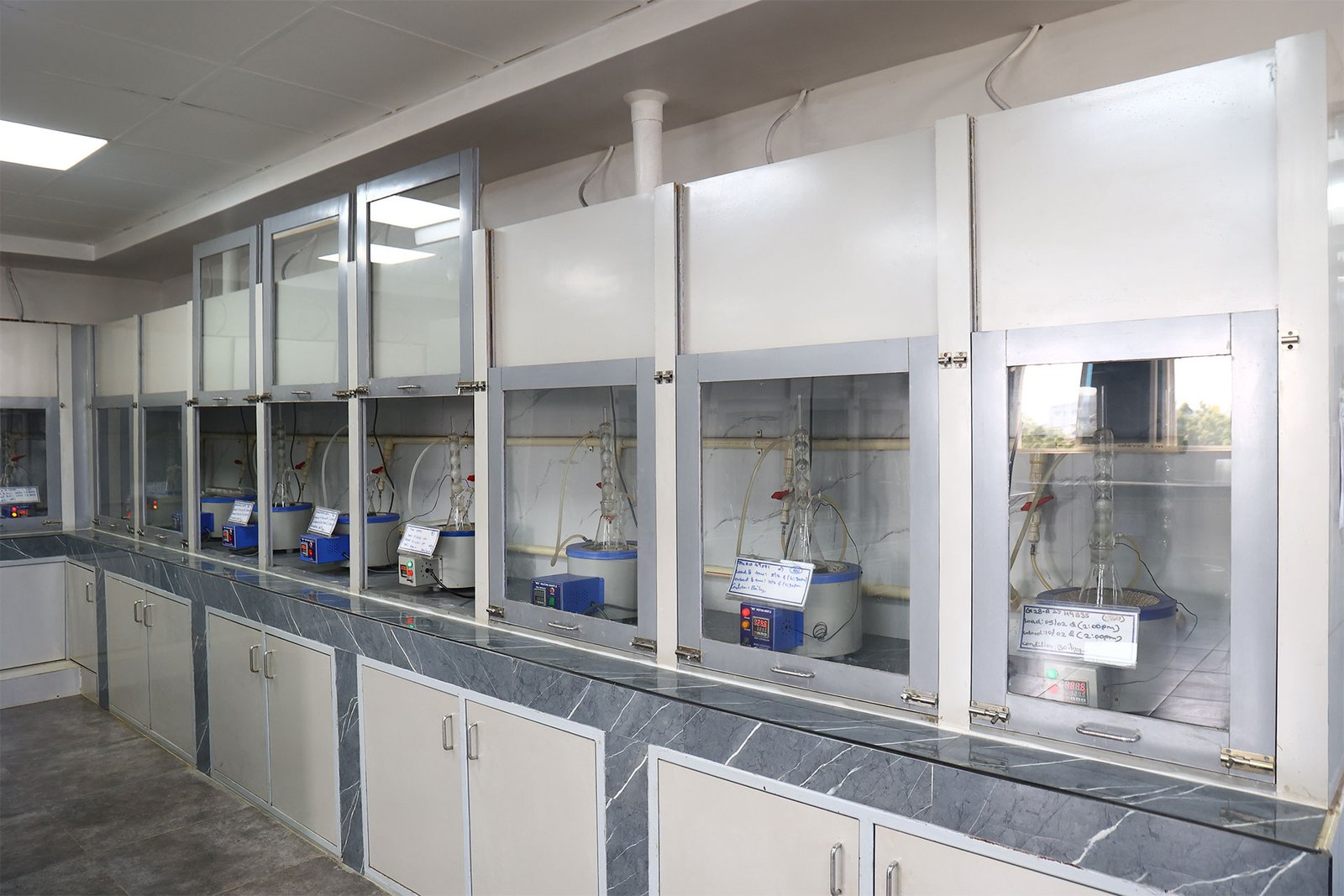
IGC test fume hoods with reflux condensers
| Test | Standard | Material | Method Details |
|---|---|---|---|
| IGC — Austenitic SS | ASTM A262 Practice A | 304, 316, 321, 347 | Oxalic acid etch — screening test for sensitisation |
| IGC — Austenitic SS | ASTM A262 Practice B | Austenitic SS | Ferric sulphate–50% H₂SO₄ (Streicher test) |
| IGC — Austenitic SS | ASTM A262 Practice C | Austenitic SS | Nitric acid (Huey test) — 5 boiling periods, weight loss |
| IGC — Austenitic SS | ASTM A262 Practice D | Austenitic SS | Nitric acid–HF (modified Huey) — Mo-containing alloys |
| IGC — Austenitic SS | ASTM A262 Practice E | Austenitic SS | Copper sulphate–H₂SO₄ (Strauss test) |
| IGC — Ferritic SS | ASTM A763 Practice W | 409, 430, 439, 444 | Oxalic acid etch screening |
| IGC — Ferritic SS | ASTM A763 Practice X | Ferritic SS | Ferric sulphate–50% H₂SO₄ |
| IGC — Ferritic SS | ASTM A763 Practice Y | Ferritic SS | CuSO₄–16% H₂SO₄ (copper sulphate–dilute sulphuric acid) |
| IGC — Ferritic SS | ASTM A763 Practice Z | Ferritic SS | CuSO₄–50% H₂SO₄ (copper sulphate–concentrated sulphuric acid) |
| IGC — Nickel Alloys | ASTM G28 Method A | Inconel, Hastelloy | Ferric sulphate–50% H₂SO₄ — 120 h boiling immersion |
| IGC — Nickel Alloys | ASTM G28 Method B | Ni-Cr-Mo alloys | Boiling 23% HCl (Ester test) — Hastelloy C family |
| IGC — Russian Standard | GOST 6032 | Austenitic SS | AM, AMU, and B methods (boiling H₂SO₄ + CuSO₄) — for export projects and Russian EPC specifications |
Pitting, Crevice & Stress Corrosion Cracking
Critical Pitting Temperature. Crevice Corrosion. SCC.
| Test | Standards | Details |
|---|---|---|
| Pitting Resistance | ASTM G48 Method A / C / E | FeCl₃ immersion (6% ferric chloride). Method A at 22°C; Methods C and E for critical pitting temperature (CPT) determination. Weight loss and pit counting per G48 protocol. |
| Crevice Corrosion | ASTM G48 Method B / D / F | FeCl₃ immersion with multiple-crevice assembly (MCA). Method B at 22°C; Methods D and F for critical crevice temperature (CCT). Duplex SS, super duplex, and Ni alloys. |
| Critical Pitting Temperature (CPT) | ASTM G48 Method C / E; ASTM G150 | Potentiostatic CPT determination by stepwise temperature increase (G150) or immersion protocol (G48). Used for PREN ranking and material approval. |
| Detrimental Phases in Duplex SS | ASTM A923 Method A / B / C | Method A: NaOH etch — intermetallic phase identification by optical microscopy. Method B: Charpy impact at −40°C. Method C: FeCl₃ pitting test at 40°C. Used for post-fabrication and PWHT verification of duplex and super duplex SS. |
| Chloride SCC | ASTM G36 | Boiling 45% magnesium chloride (MgCl₂) immersion for stress corrosion cracking of austenitic stainless steels. U-bend or tension specimens at constant applied stress. |
| SCC — General | ASTM G30, G39, G44 | G30: U-bend specimen preparation and use. G39: Bent-beam stress corrosion specimens. G44: Alternate immersion in 3.5% NaCl solution. Covers austenitic, precipitation hardened, and aluminium alloys. |
Salt Spray & Environmental Corrosion
Up to 5000+ Hours. NSS, ASS, CASS, Cyclic, SO₂.
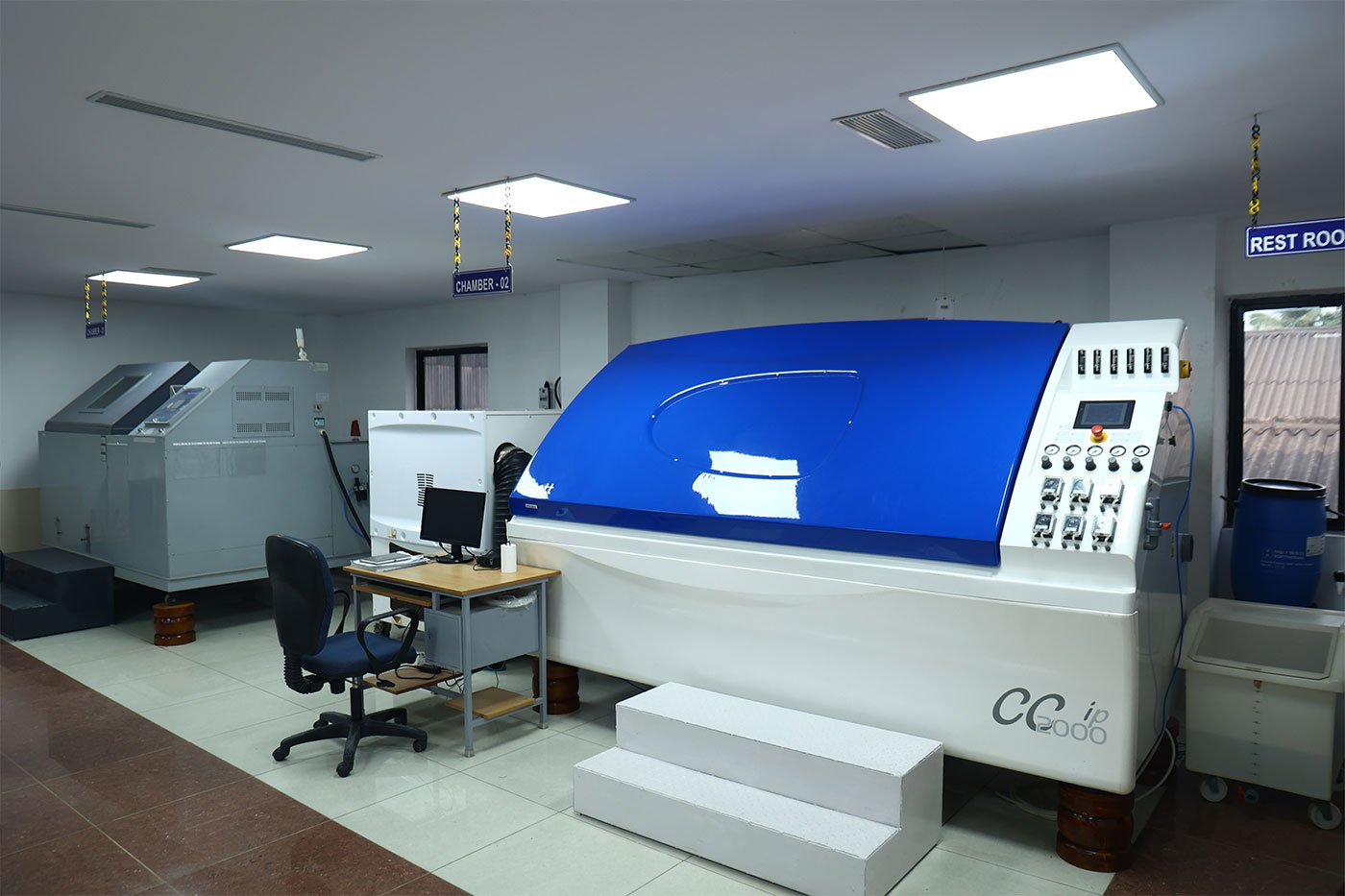
CC2000ip cyclic corrosion chamber — 2000L capacity, ASTM B117
| Test | Standards | Details |
|---|---|---|
| Neutral Salt Spray (NSS) | ASTM B117, ISO 9227 | 5% NaCl fog at 35°C. Continuous exposure up to 5000+ hours. Used for coatings, platings, and painted metal components. Most widely specified accelerated corrosion test. |
| Acetic Acid Salt Spray (ASS) | ASTM B117, ISO 9227 | 5% NaCl + acetic acid, pH 3.1–3.3. More aggressive than NSS. Used for decorative chrome and anodised aluminium coatings. |
| Copper Accelerated Salt Spray (CASS) | ASTM B117, ISO 9227 | 5% NaCl + acetic acid + copper chloride at 50°C. Highly accelerated. For decorative copper/nickel/chrome and similar multilayer coatings. |
| Immersion Corrosion Testing | ASTM G31 | Weight loss method. Laboratory immersion testing in various corrosive media (acids, alkalis, process fluids, saline solutions). Corrosion rate (mpy/mmpy), pitting, and selective attack evaluation. |
| Cyclic Corrosion Testing | SAE J2334, GMW 14872 | Multi-step cyclic protocols: humidity, salt spray, and dry phases. OEM automotive qualification — General Motors (GMW 14872), Ford (CETP 00.00-L-467), SAE J2334. Closer correlation to field corrosion than NSS alone. |
| Humidity Chamber | ASTM D2247, IEC 60068-2-78 | Constant humidity (98% RH at 40°C) or cyclic humidity. Corrosion, blistering, and adhesion loss evaluation for paints, coatings, and electrical assemblies. |
| Kesternich (SO₂ Corrosion) | DIN 50018, ISO 6988 | Sulphur dioxide atmosphere corrosion test. Simulates industrial and urban pollution environments. Used for automotive, electrical, and decorative finishes requiring SO₂ resistance certification. |
Electrochemical Testing
Potentiodynamic. EIS. Galvanic. Corrosion Rate.
Potentiodynamic Polarisation
Thermo Fisher + Zeiss + COXEM FE-SEMs. nm-resolution fractography, EDS elemental mapping, EBSD orientation mapping, phase identification — the investigative tools that close failure cases on corroded products.
- ASTM G5
- ASTM G61
Potentiostatic Testing
Constant potential hold to determine passive current density, transpassive dissolution onset, and stable pit nucleation thresholds. Supports CPT and CCT determination in conjunction with G48 immersion protocols.
- ASTM G59
Cyclic Polarisation
Forward and reverse potential sweeps to measure pitting potential (Eₕ) and repassivation potential (Eₐ). Protection potential determination. Evaluates susceptibility to stable pit growth vs. metastable pitting. Critical for stainless steels in chloride media.
- ASTM G61
Electrochemical Impedance Spectroscopy (EIS)
Frequency-response analysis to characterise coating barrier properties, oxide film integrity, and charge-transfer resistance. Equivalent circuit modelling. Non-destructive — suitable for long-term exposure monitoring of coatings and inhibitor films.
- EIS
- Bode / Nyquist
Galvanic Corrosion
Galvanic current and potential measurements for dissimilar metal couples in representative electrolytes. Zero-resistance ammeter (ZRA) technique. Used for design validation of bi-metallic assemblies, fastener material selection, and cathodic protection assessments.
- ASTM G71
Corrosion Rate Measurement
Linear polarisation resistance (LPR) method for rapid, non-destructive corrosion rate determination. Corrosion current density from Stern-Geary equation. Suitable for inhibitor evaluation, process fluid screening, and QA monitoring programmes. Results reported in mpy and mm/year.
- LPR
- ASTM G96
Coating & Metallic Protection
Zinc Mass. Holiday. Cathodic Disbondment. DFT & Adhesion.
| Test | Standards | Details |
|---|---|---|
| Zinc Coating Mass | ASTM A90, IS 2629 | Gravimetric determination of zinc mass per unit area on hot-dip galvanised and electrogalvanised steel. Stripping solution method (HCl + antimony trioxide inhibitor). Minimum coating mass verification per ASTM A123, A153, IS 4736. |
| Phosphate Coating Mass | IS 6745 | Coating weight (g/m²) determination for zinc and manganese phosphate conversion coatings. Pre-paint treatment quality control and military specification compliance. |
| Metallic Coating Thickness | ASTM B137, B487 | B137: Magnetic thickness for electrolytic coatings (zinc, cadmium, tin). B487: Metallographic cross-section method for electrodeposited and other metallic coatings. Accurate to <1 μm. Used where non-destructive methods cannot resolve thin coatings. |
| Holiday Test (Coating Porosity) | ASTM D5162, NACE SP0188 | Low-voltage (wet sponge) and high-voltage (spark) porosity testing for organic and fusion-bonded epoxy (FBE) coatings on metal substrates. Holiday detection down to pin-hole level. Used for pipeline coating inspection and tank lining qualification. |
| Cathodic Disbondment | ASTM G8, ASTM G42 | G8: Cathodic disbondment at ambient temperature for pipeline coatings (24 h and 30-day options). G42: Elevated temperature (65°C) disbondment for buried and submerged pipeline coatings. Disbondment radius and adhesion retained under cathodic protection conditions. |
| DFT & Cross-Cut Adhesion | ASTM D7091, ASTM D3359 | D7091: Non-destructive dry film thickness (DFT) measurement on ferrous and non-ferrous substrates using magnetic and eddy-current gauges. D3359: Cross-cut tape adhesion — Classification 0B to 5B per ASTM scale. Used for paint, powder coat, and organic coating QC. |
Industry Applications
Who Uses Our Corrosion Testing Services
From upstream oil & gas to final automotive OEM delivery, our corrosion laboratory supports qualification, QA, and failure investigation across industry sectors.
Oil & Gas
SSCC/HIC qualification for linepipe, valves, and wellhead equipment. Sour service material certification per NACE MR0175 / ISO 15156. Downhole tubular corrosion allowance determination.
Petrochemical
IGC testing for stainless steel vessels and heat exchangers. Pitting and crevice resistance for process equipment in aggressive media. Weld sensitisation verification.
Power
Boiler tube corrosion assessment. High-temperature oxidation and scaling tests. Condenser tube pitting evaluation. IGC for superheater and reheater alloys.
Marine & Offshore
CTOD and SCC for offshore structural steels. Subsea coating qualification (cathodic disbondment, holiday). Galvanic compatibility for dissimilar metal joints in seawater.
Automotive
OEM cyclic corrosion protocols (GMW 14872, SAE J2334). Salt spray for body-in-white and underbody coatings. Zinc coating mass for galvanised sheet. Electrocoat and primer adhesion.
Aerospace
SCC susceptibility of aluminium alloys (G44, G47). Exfoliation corrosion. Anodise and hard-chrome qualification. Accelerated salt spray per MIL-STD-889.
Chemical Processing
Material compatibility immersion testing in process acids, alkalis, and solvents. IGC and pitting for Ni alloy and duplex SS reactor internals. EIS for inhibitor package validation.
Not sure which test applies to your material or specification?
Method Selection Framework
Choosing the right corrosion test depends on your objective
Material Qualification
Pre-procurement / incoming inspection
SSC (NACE TM0177), HIC (TM0284), IGC (ASTM A262/G28) — verifying material meets sour-service, sensitisation, or corrosion-resistance requirements before installation.
- NACE TM0177 · TM0284 · ASTM A262 · G28
Ranking / Comparison
Material selection or alloy comparison
Pitting resistance (ASTM G48), salt spray (B117), electrochemical (potentiodynamic) — ranking candidate alloys or coatings against each other under controlled exposure conditions.
- ASTM G48 · B117 · G5 · G61
Root-Cause Investigation
Failed component analysis
Metallographic cross-section of attack morphology, SEM/EDS of corrosion products, chemistry verification — determining whether failure is material-related, environment-related, or design-related.
- Visual + metallography + SEM/EDS + chemistry
Coating Validation
Paint/coating system qualification
Salt spray (B117), cyclic corrosion (G85), scribe creep, adhesion before/after exposure — qualifying coating systems for OEM or specification compliance.
- ASTM B117 · G85 · D4541 · D3359
Environmental Control Envelopes
Measurable test conditions across our corrosion laboratory
| Test Method | Environment | Temperature | Duration |
|---|---|---|---|
| SSC (NACE TM0177) | 5% NaCl + 0.5% acetic acid, H₂S saturated | 24 °C ± 3 °C | 720 hours standard |
| HIC (NACE TM0284) | NACE Solution A or B, H₂S saturated | 25 °C ± 3 °C | 96 hours |
| Salt Spray (ASTM B117) | 5% NaCl fog | 35 °C ± 2 °C | 24 to 10,000+ hours |
| Cyclic Corrosion (ASTM G85) | Salt fog + dry + humid cycling | Variable (25–49 °C) | Per OEM specification |
| IGC — Strauss (ASTM A262-E) | Boiling CuSO₄ + H₂SO₄ + Cu chips | Boiling (~120 °C) | 24–120 hours |
| IGC — Huey (ASTM A262-C) | Boiling 65% HNO₃ | Boiling (~120 °C) | 5 × 48-hour periods |
| Pitting (ASTM G48) | 6% FeCl₃ solution | 22 °C or 50 °C | 24–72 hours |
5–7 Days*
Standard Turnaround
4–5 Days*
Express Available
ISO 17025:2017
Reporting Structure
Related Services
Metals Testing
Mechanical, chemical, and metallographic testing of ferrous and non-ferrous metals
Environmental Testing
Xenon arc, UV weathering, thermal shock, and humidity cycling
Paints & Coatings
DFT, adhesion, hardness, gloss, salt spray, and coating qualification
Metallography & Failure Analysis
Microstructure examination, root cause failure analysis, and fractography
Need a Trustworth Corrosion Test Report ?
Discuss your test matrix with our corrosion team. We will confirm method, specimen requirements, H₂S handling, and turnaround time. Complete end-to-end from sample pickup and return to your company.