
- Home
- / Services
- / Environmental & Weathering Testing
Simulate Years of
Exposure in Days
for automotive, aerospace, electronics, and industrial applications.
Environmental Testing Overview
Complete Environmental Durability Under One Roof
From xenon arc weathering and thermal shock to cyclic corrosion, IP rating, and OEM paint qualification — Microlab delivers the full environmental test suite required by automotive, aerospace, and electronics OEMs.
6
Weathering chamber types — Xenon, UV-A, UV-B, Carbon Arc, Salt Spray, Cyclic Corrosion
−70°C
Lowest cold test temperature; thermal shock from −40°C to +150°C with rapid ramp
IP69K
Full IP rating suite — IP5X/6X dust ingress and IPX1 through IPX9K water ingress per IEC 60529
OEM
MS 655-10, MS 652-15, TSH 1601G paint system qualification; fogging, VOC, flammability
HALT
Combined vibration + thermal testing for HALT/HASS-style product reliability screening
ISO 17025:2017
Reports accepted by OEMs, government agencies, and export markets
Section 1
Accelerated Weathering
| Test | Standards | Details |
|---|---|---|
| Xenon Arc Weathering | ASTM G155, ISO 4892-2 | Full spectrum sunlight simulation. Type BH (borosilicate/heat-absorbing) and BHA (borosilicate/heat-absorbing with additional UV filter) filter combinations. Programmable irradiance, temperature, and moisture cycles. |
| UV Fluorescent Weathering | ASTM G154, ISO 4892-3 | UVA-340 lamps for daylight simulation (peak 340 nm); UVB-313 lamps for aggressive accelerated testing. Condensation and spray cycles. |
| Carbon Arc Weathering | ASTM G152 | Open-flame carbon arc. Legacy OEM specifications and comparative qualification. Single and twin carbon arc configurations. |
| Color Retention (ΔE) | ASTM D2244, ASTM D1729 | CIE L*a*b* colorimetric measurement before and after exposure. ΔE color shift quantification. Visual assessment per D1729 under standard illuminants. |
| Gloss Retention | ASTM D523 | Specular gloss measurement at 20°, 60°, and 85° geometry. Percentage gloss retention reported after defined exposure intervals. |
| Chalking Assessment | ASTM D4214 | Tape lift and photographic rating of surface chalking. Numerical grade (0–10) for surface degradation of exterior coatings and paints. |
Section 2
Environmental Simulation
| Test | Standards | Details |
|---|---|---|
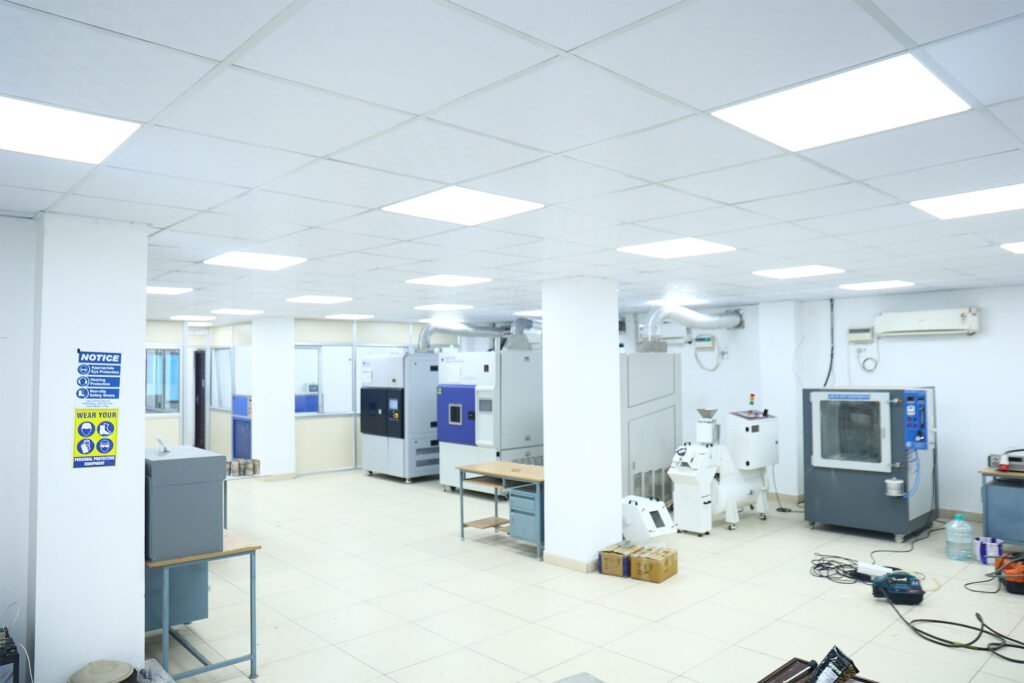
| Temperature Cycling / Thermal Shock | IEC 60068-2-14 | Rapid thermal transitions from −40°C to +150°C. Transfer time <30 seconds between zones. Programmable dwell, ramp rate, and cycle count. Na (thermal shock) and Nb (temperature cycling) test methods. |
| Humidity Testing | IEC 60068-2-78, ASTM D2247 | Constant damp heat at 85°C / 85% RH (Ca test). Cyclic humidity with temperature steps. Condensation testing. Dew-point controlled chambers. |
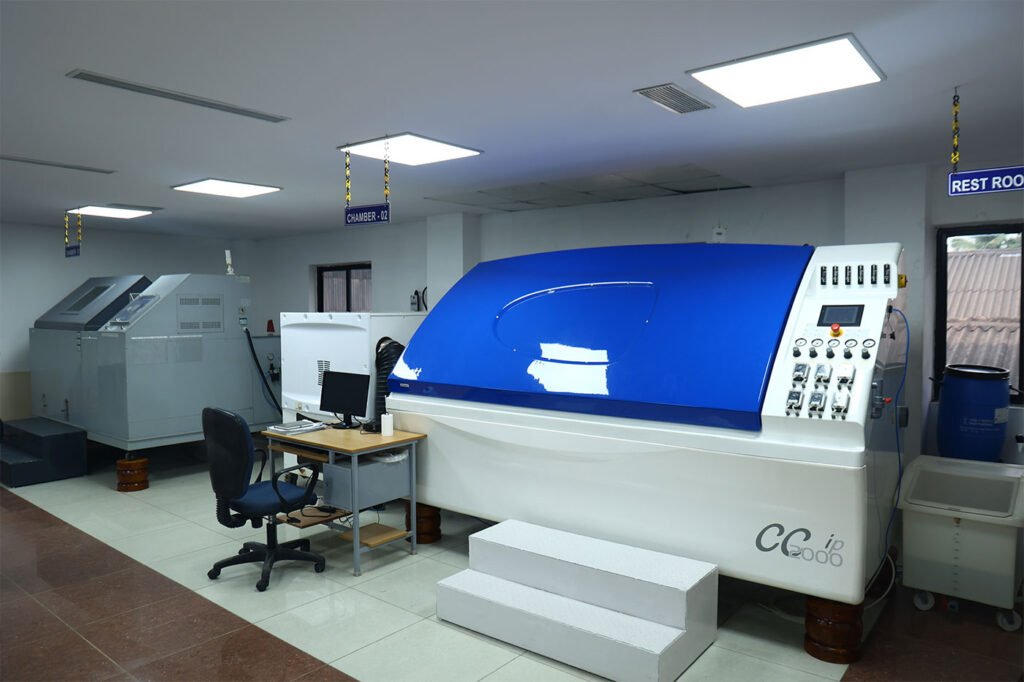
| Salt Spray — NSS / ASS / CASS | ASTM B117, ISO 9227 | Neutral Salt Spray (NSS), Acetic Acid Salt Spray (ASS), and Copper-Accelerated Acetic Acid Salt Spray (CASS). Corrosion resistance evaluation of metallic coatings, paints, and platings. |
| Cyclic Corrosion Testing | SAE J2334, GMW 14872 | Combined cycling of salt solution, high humidity, and controlled drying phases. Simulates real-world corrosion more accurately than continuous salt spray. Automotive OEM approved profiles. |
| Kesternich Test (SO₂) | DIN 50018 | Sulphur dioxide corrosion in a condensate-water atmosphere. Industrial and urban pollution simulation. 0.2 and 2.0 litre SO₂ concentrations. Used for hardware, fasteners, and surface-treated components. |
| IP Rating Testing | IEC 60529 | Solid particle ingress: IP5X (dust-protected) and IP6X (dust-tight). Water ingress: IPX1 (dripping) through IPX8 (continuous immersion) and IPX9K (high-pressure, high-temperature jets). Full test rig with calibrated nozzles and flow meters. |
| Thermal Aging | IEC 60068-2-2 | Extended high-temperature exposure (Test Bb/Bc). Evaluates long-term stability of materials, components, and insulation systems at elevated temperatures. Temperature to +300°C in precision ovens. |
| Cold Testing | IEC 60068-2-1 | Low-temperature exposure from −40°C to −70°C (Test Ab/Ad). Product functionality verification and embrittlement assessment of plastics, rubber seals, and electronic assemblies at sub-zero temperatures. |
Section 3
Automotive Environmental Qualification
Paint Systems
OEM Paint Qualification
Complete paint system evaluation per OEM paint standards. Weathering exposure, adhesion, gloss, chalking, color shift, and corrosion resistance evaluated as an integrated system.
- MS 655-10
- MS 652-15
- TSH 1601G
Interior Materials
Fogging, VOC & Odor
Fogging (condensate and reflectometric methods) per SAE J1756 and DIN 75201. VOC and SVOC analysis of interior trim materials. Odor assessment for cabin air quality compliance.
- SAE J1756
- DIN 75201
- VOC/SVOC
Component Durability
Vibration + Thermal + IP
Combined environmental qualification for automotive components: vibration profiles (sinusoidal, random), thermal cycling, and IP rating in sequence or combined. Maps to OEM component qualification plans.
- IEC 60068-2-6
- IEC 60068-2-14
- IEC 60529
Plastics & Rubber Aging
UV, Ozone, Heat & Chemical
Accelerated aging for interior and exterior plastics and rubber seals. UV exposure, ozone resistance (ASTM D1149), heat aging per ASTM D573, and immersion in automotive fluids (fuel, oil, coolant, brake fluid).
- ASTM D573
- ASTM D1149
- Fluid resistance
Flammability
Interior & Material Flammability
Horizontal burning rate for automotive interior materials. Vertical flame testing for electrical components and wire harnesses. Multiple international standards supported.
- UL 94
- FMVSS 302
- ISO 3795
- ASTM D5132
Corrosion Qualification
Cyclic Corrosion & Salt Spray
Full corrosion qualification for body panels, fasteners, and underbody components. Cyclic corrosion per SAE J2334 / GMW 14872 plus CASS and NSS. Pre- and post-corrosion mechanical testing available.
- SAE J2334
- GMW 14872
- ASTM B117
Section 4
Vibration & Mechanical Environmental Testing
Electrodynamic and servo-hydraulic vibration systems for sinusoidal, random, and combined-environment testing. IEC 60068 methods for components, assemblies, and packaged products.
| Test | Standards | Details |
|---|---|---|
| Sinusoidal Vibration | IEC 60068-2-6 | Swept sine vibration — frequency range 1 Hz to 2000 Hz. Resonance search and dwell at resonance frequencies. Fatigue screening and response characterisation for electronic assemblies and mechanical components. |
| Random Vibration | IEC 60068-2-64 | Broadband random vibration with programmable PSD (Power Spectral Density) profiles. Simulates road vibration, transport, and in-service environments. Fatigue life correlation. |
| Sine-on-Random | — | Combined sinusoidal tones superimposed on broadband random vibration. Replicates complex real-world vibration environments such as engine harmonics on a broadband road input. |
| Mechanical Shock | IEC 60068-2-27 | Half-sine, trapezoidal, and sawtooth shock pulses. Peak acceleration and pulse duration per OEM and IEC specifications. Evaluates component robustness against sudden impacts and handling drops. |
| Combined Vibration + Thermal | — | Simultaneous vibration (sinusoidal or random) with controlled temperature cycling. HALT (Highly Accelerated Life Test) and HASS (Highly Accelerated Stress Screen) style testing to precipitate latent defects rapidly. |
| Bump Testing | IEC 60068-2-29 | Repetitive mechanical shock (bump test). Low-level, high-repetition shock pulses to simulate handling, transport, and in-service bump loads. Structural integrity and connector reliability assessment. |
Servo-hydraulic structural endurance: Our ±400 kN, 8-channel servo-hydraulic system supports combined axial load + vibration testing for automotive axles, sub-frames, and suspension components. Frequency range 0.001 to 100 Hz. Real-world road load data replication.
Section 5
Reliability & Product Qualification
Structured qualification programs that take a product from design validation through production verification — aligned to OEM, military, and international reliability standards.
Automotive Tier-1 Qualification
Complete environmental qualification plans for automotive components including thermal cycling, humidity, salt spray, vibration, IP rating, and flammability in OEM-specified sequence. DVP&R support. Reports accepted by major OEMs and Tier-1s.
Electronics Environmental Testing
Thermal cycling (solder joint reliability), humidity (85°C/85%RH), vibration, shock, and combined HALT/HASS testing for PCBs, connectors, sensors, and ECUs. IEC 60068 test suite. Failure analysis post-stress by FE-SEM and cross-section.
Packaging Integrity & Transport Simulation
Defence & Military Environmental Standards
Environmental testing aligned to MIL-STD-810 (temperature, humidity, salt fog, vibration, shock, altitude) and DEF STAN 00-35. Qualification reports for defence procurement. Combined environment capability for military electronics and equipment.
Industry Applications
Who We Test For
Environmental and weathering testing across six key sectors — each with unique standards, failure modes, and durability expectations.
Chemical & Spectroscopy
OES, ICP-OES, XRF, wet chemistry, combustion analysis. Grade identification, trace-element analysis, and compositional certification for procurement.
Aerospace
Temperature extremes, altitude simulation, humidity, salt fog, vibration, and combined environment testing for avionic components, structural composites, and sealing systems.
Electronics
Thermal cycling for solder reliability, 85°C/85%RH humidity, HALT/HASS, vibration, IP rating, mechanical shock. PCBs, connectors, power electronics, and consumer devices.
Packaging
Transport simulation (vibration, drop, compression), humidity cycling for corrugated board, cold-chain packaging integrity, and adhesive tape environmental resistance.
Defence
MIL-STD-810 and DEF STAN 00-35 compliant testing. Temperature, humidity, salt fog, vibration, shock, and combined environments for military electronics, vehicles, and equipment.
Solar & Renewable Energy
UV and xenon weathering for encapsulants and backsheets, thermal cycling for junction boxes and modules, humidity-freeze, damp heat (IEC 61215), and salt mist testing for coastal installations.
Qualification Matrix by Exposure Mode
| Exposure Mode | Test Methods | Standards | Typical Applications |
|---|---|---|---|
| UV / Sunlight | Xenon arc, UV fluorescent (QUV), outdoor exposure | ASTM G154, G155, ISO 4892, ISO 16474 | Automotive exterior, building products, coatings |
| Temperature Cycling | Thermal shock, temperature cycling chambers | IEC 60068-2-14, MIL-STD-810 | Electronics, automotive under-hood, aerospace |
| Humidity | Constant humidity, cyclic humidity, damp heat | IEC 60068-2-78, ISO 6270 | Electronics, coatings, packaging |
| Salt Fog | Neutral salt spray, acetic acid salt spray, CASS | ASTM B117, ISO 9227, ASTM G85 | Automotive, marine, fasteners, coatings |
| Vibration / Shock | Sine, random, shock pulse, combined with temperature | ISO 16750, IEC 60068-2-6, MIL-STD-810 | Automotive, defence, electronics, industrial |
| IP / Water Ingress | IP54 through IP67 water spray and immersion | IEC 60529 | Enclosures, connectors, outdoor equipment |
-70 to +200 °C
Temperature
range
10–98% RH
10,000+ hrs
Max salt spray
duration
5–2000 Hz
Vibration
frequency
Failure Criteria & Assessment
What you receive in our test reports
Visual / Appearance
Colour change (ΔE measurement), gloss retention, chalking, cracking, blistering (ASTM D714), rust creep from scribe (ASTM D1654). Photographic documentation at intervals.
Mechanical Property Retention
Tensile, impact, or flexural testing before and after environmental exposure. Percentage retention of original properties against specification minimums.
Adhesion Retention
Cross-cut (ASTM D3359), pull-off (ASTM D4541), or scratch adhesion before and after exposure. Pass/fail per specification or quantitative comparison.
Functional Performance
Electrical continuity, seal integrity, dimensional stability, operational test — verifying the component still functions after environmental conditioning.
1-90+ Days
Customized duration
Raw Data
Graphs, Images and more
ISO 17025:2017
Reports
Related Services
Corrosion Testing
SSCC, HIC, IGC, salt spray, pitting, and electrochemical corrosion evaluation
Paints & Coatings
DFT, adhesion, hardness, gloss, salt spray, and coating qualification
Structural Testing
Component endurance, durability, vibration, and IP rating validation
Product Validation
OEM qualification, environmental endurance, vibration, and IP rating testing