
- Home
- / Services
- / Fatigue, Fracture & Creep Testing
First Commercial Fracture
Mechanics Lab
in South India
KIC, JIC, CTOD, da/dN, LCF/HCF, creep/stress rupture — from room temperature to 1000°C. Tested, characterized, and reported by engineers who understand the failure mode.
Flagship Capability
Fracture Toughness Testing
The most demanding fracture mechanics characterisations — all performed in-house on calibrated servo-electric & hydraulic systems with reliable results and engineering sign-off.
Linear-Elastic
KIC
Plane-Strain Fracture Toughness
- Compact Tension (CT), Single Edge Bend (SEB), Disk-Shaped CT (DCT), Arc-Shaped Tension (AT), Arc-Shaped Bend (AB)
- Temperature: −196°C (cryogenic with LN₂) to +300°C
- Steels, aluminium alloys (B645), copper alloys (B646), titanium alloys (B909)
- Full validity check to E399 Annex; KQ reported when validity not met
- ASTM E399
- B645
- B646
- B909
- ISO 12135
- BS 7448-1
Elastic-Plastic
JIC
J-Integral Fracture Toughness
- Rising load method (single-specimen) and partial unloading compliance (multi-point J-R curve)
- J-R curve generation for ductile tearing characterisation
- Conversion to KJC and KJIC equivalents reported
- For materials where plane-strain conditions cannot be met at practical specimen sizes
- ASTM E1820
- ISO 12135
- BS 7448-1
Crack Tip Opening Displacement
CTOD
δ — Critical & Initiation Values
- Critical for pipeline steels, offshore structures, and weld qualification projects
- Weld CTOD: parent metal, weld metal, and HAZ locations per BS 7448-2 and ISO 15653
- SENB and CT specimen configurations
- δc, δu, δm, δi values reported as applicable
- ASTM E1820
- E2818
- ISO 12135
- BS 7448-1/2
- ISO 15653
Conditional Toughness
KQ
Validity-Assessed Result
- When specimen dimensions do not satisfy E399 validity requirements for plane-strain
- KQ reported with full validity assessment documentation
- Includes recommendation on required specimen size for valid KIC
- Useful for material screening, comparative ranking, and structural assessment input
- ASTM E399 Annex
Pre-cracking in-house: All fracture toughness specimens are fatigue pre-cracked to ASTM E399/E1820/E647 requirements on our own servo-electric systems. Crack length verification by optical measurement on both faces. No outsourcing at any stage — from machining to pre-cracking to testing to reporting.
Fatigue Testing
HCF, LCF, da/dN — Complete Fatigue Characterisation
From endurance-limit S-N curves to crack-propagation Paris Law constants. Axial, rotating bending, torsional, and biaxial loading modes. Corrosion fatigue and thermo-mechanical fatigue on request.
| Test | Description | Standards | Capacity / Notes |
|---|---|---|---|
| HCF — High Cycle Fatigue | S-N curve generation, endurance limit determination, R-ratio effects, mean stress effects (Goodman, Gerber) | ASTM E466 ISO 12110 | 106–107 cycles; axial load-controlled; multiple R-ratios |
| LCF — Low Cycle Fatigue | Strain-life (ϵ-N) curve, cyclic stress-strain response, Bauschinger effect, cyclic hardening/softening | ASTM E606 ISO 12106 | Strain-controlled with extensometer; fully-reversed and mean-strain tests |
| Fatigue Crack Growth (da/dN) | Crack growth rate vs. ΔK (Paris Law), threshold ΔKth, R-ratio effects, near-threshold and upper-shelf behaviour | ASTM E647 ISO 12108 | CT and SEB specimens; optical + compliance crack monitoring; load-shedding for threshold |
| Rotating Bending Fatigue | Wöhler-type S-N curves for round bars, shafts, and axles under rotating bending moment | ISO 1143 DIN 50113 | Dedicated rotating bending machine; R = −1 fully reversed |
| Torsional Fatigue | Fatigue of drivetrain components, shafts, and torsion-loaded structures under cyclic torsion | — | 500 Nm capacity; pure torsion or combined loading |
| Axial-Torsional Biaxial Fatigue | Combined axial and torsional loading; proportional and non-proportional paths | — | 200 Nm axial-torsional servo-electric system |
| Thermo-Mechanical Fatigue (TMF) | Simultaneous thermal cycling and mechanical loading; in-phase (IP) and out-of-phase (OP) TMF | — | For turbine blade alloys, exhaust components; temperature & strain controlled |
| Corrosion Fatigue | Fatigue life in aggressive environments: saline, sour gas (H₂S), acid — environment reduces crack initiation and propagation resistance | — | Environmental chambers; for offshore, subsea, oil & gas components |
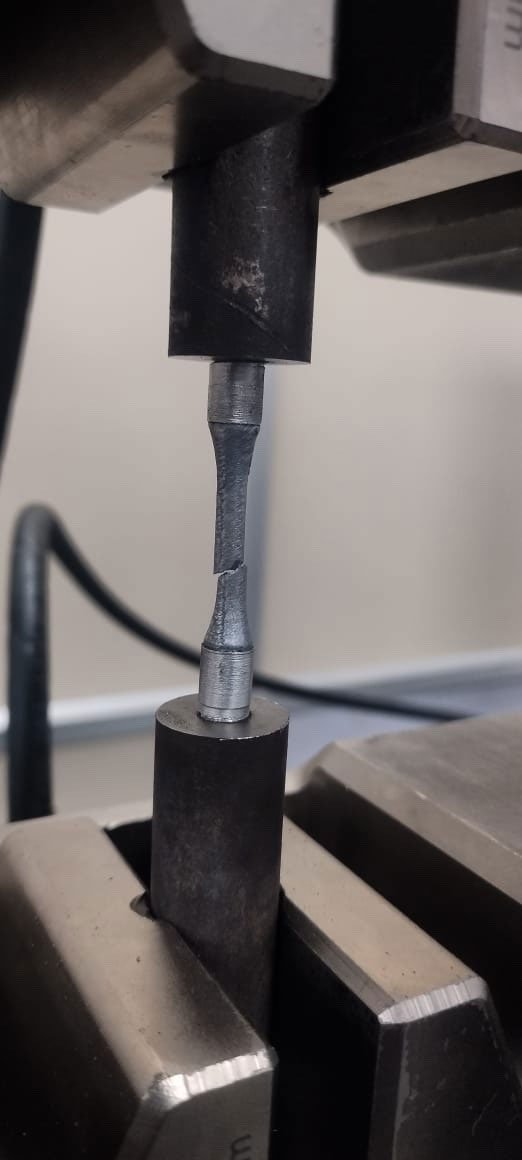
HCF specimen fractured at gauge section
High-Temperature Testing
Creep, Stress Rupture & Relaxation
Twenty-plus servo-electric creep machines — the largest private-sector creep testing capacity in India. Continuous load and temperature logging. Individual furnace per station. Triple-zone temperature control to ±1°C.
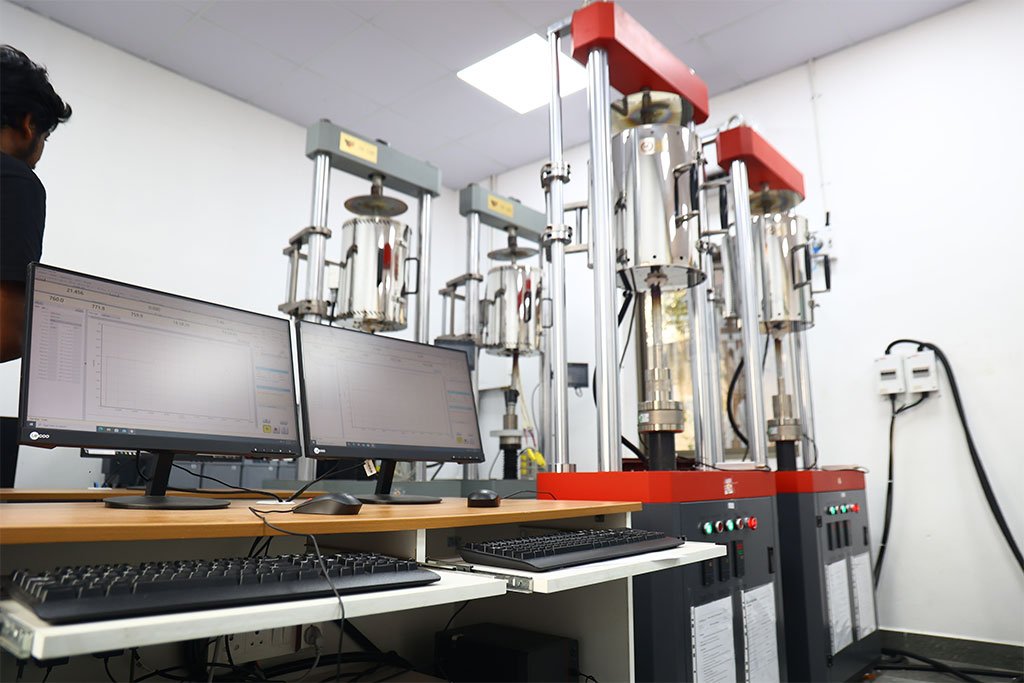
Multi-station creep rupture machines with continuous data acquisition
| Test | Description | Standards | Notes |
|---|---|---|---|
| Creep Testing | Strain vs. time under constant uniaxial load at elevated temperature; primary, secondary, and tertiary creep stage characterisation | ASTM E139 ISO 204 | RT to 1000°C; individual furnace per test station; extensometer for strain measurement |
| Stress Rupture | Time-to-fracture under constant stress and temperature; Larson-Miller parameter determination; extrapolation to service life | ASTM E139 ASTM E292 ISO 204 | Notch rupture ratio (notched vs. plain); stress rupture ductility; multiple stress levels per test series |
| Stress Relaxation | Decay of stress under constant total strain at elevated temperature; critical for bolted joints, gaskets, pre-stressed components | ASTM E328 | Bolting materials, flange gaskets, spring applications; reported as residual stress vs. time |
| Creep Crack Growth | Crack propagation under sustained load at elevated temperature; C* parameter characterisation for power plant & petrochemical piping | — | For remaining life assessment of in-service components; P91/P92 steels, Inconel |
20+
Creep Machines
1000°C
±1°C
Servo-Electric Creep Testing Fleet
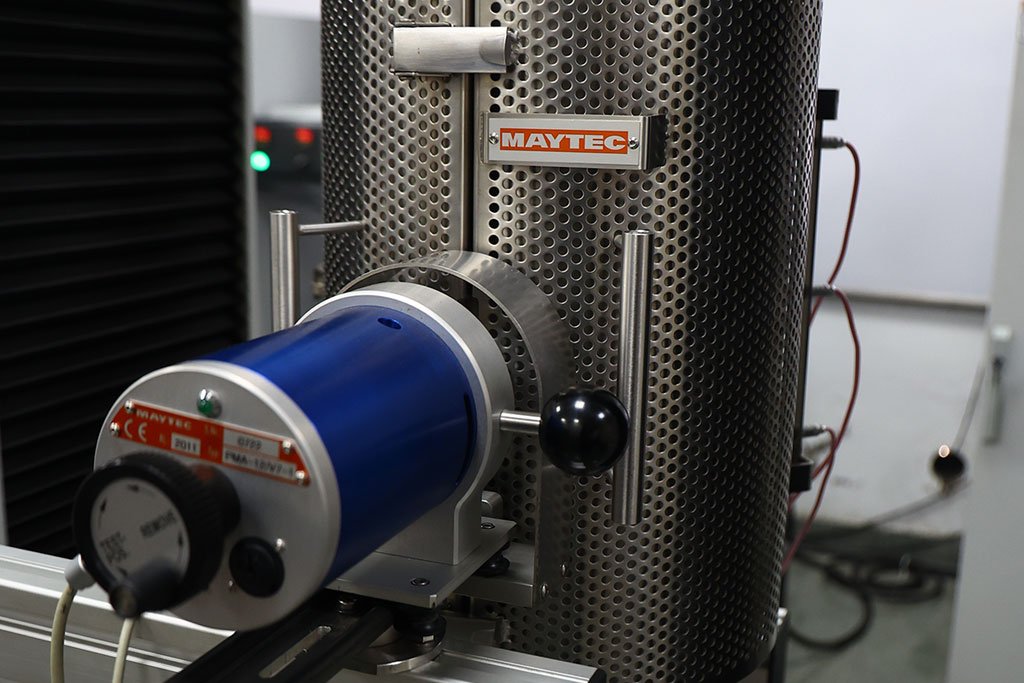
Maytec high-temperature extensometer on servo-hydraulic frame
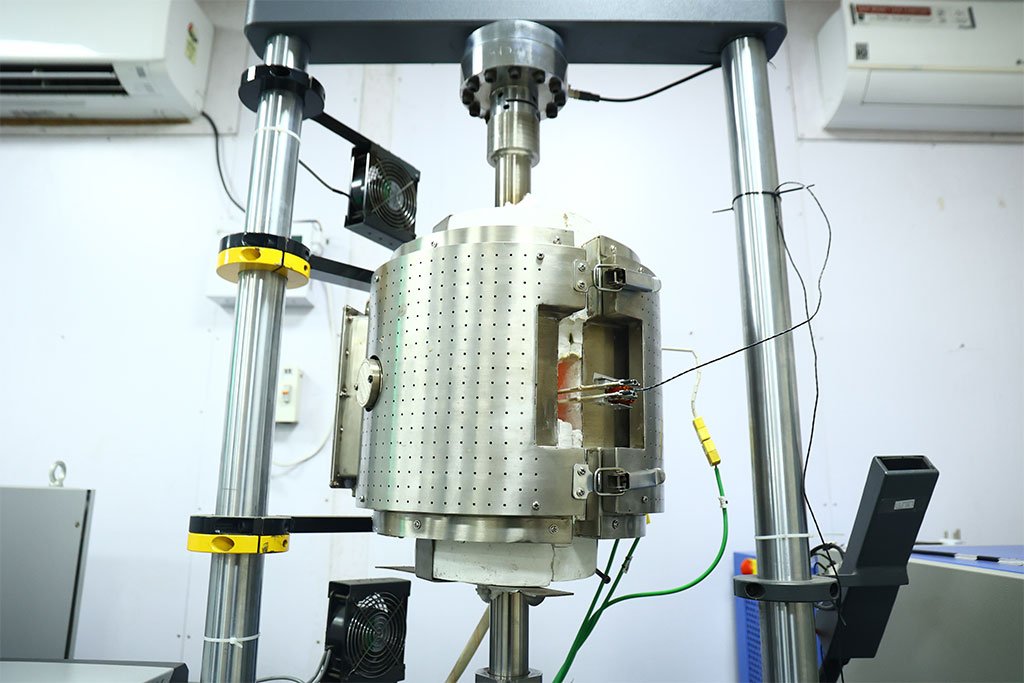
Split furnace for high-temperature tensile and creep testing
Specimen Preparation
In-House Specimen Machining & Geometries
CNC turning centres, VMC, and EDM wire-cut on-site. All specimens machined and verified in-house. No outsourcing. No custody gaps.
- CT
Compact Tension
Most common geometry for KIC and da/dN. Machined to E399/E647 tolerances with EDM notch.
- SEB
Single Edge Bend
For CTOD and KIC. Weld-centre, HAZ, and parent metal positions. BS 7448-2 / ISO 15653 weld specimens.
- DCT
Disk-Shaped CT
For cylindrical billets and bar stock where standard CT is not feasible. Per ASTM E399 Annex A2.
- RB
Round Bar Fatigue
For S-N and LCF testing. Hourglass or straight gauge length. Ground and polished finish.
- FB
Flat Dog-Bone
For sheet, plate, and thin-section fatigue. Pin-loaded or hydraulic-gripped ends. E466 / E606 geometry.
- CR
Creep Specimens
Round bar with threaded ends per ASTM E139. Gauge length extensometered. Ground finish for accurate diameter.
All specimens machined in-house on CNC turning centres, VMC, and EDM wire-cut. No outsourcing. No custody gaps. Traceability from raw material receipt to final tested specimen is maintained throughout.
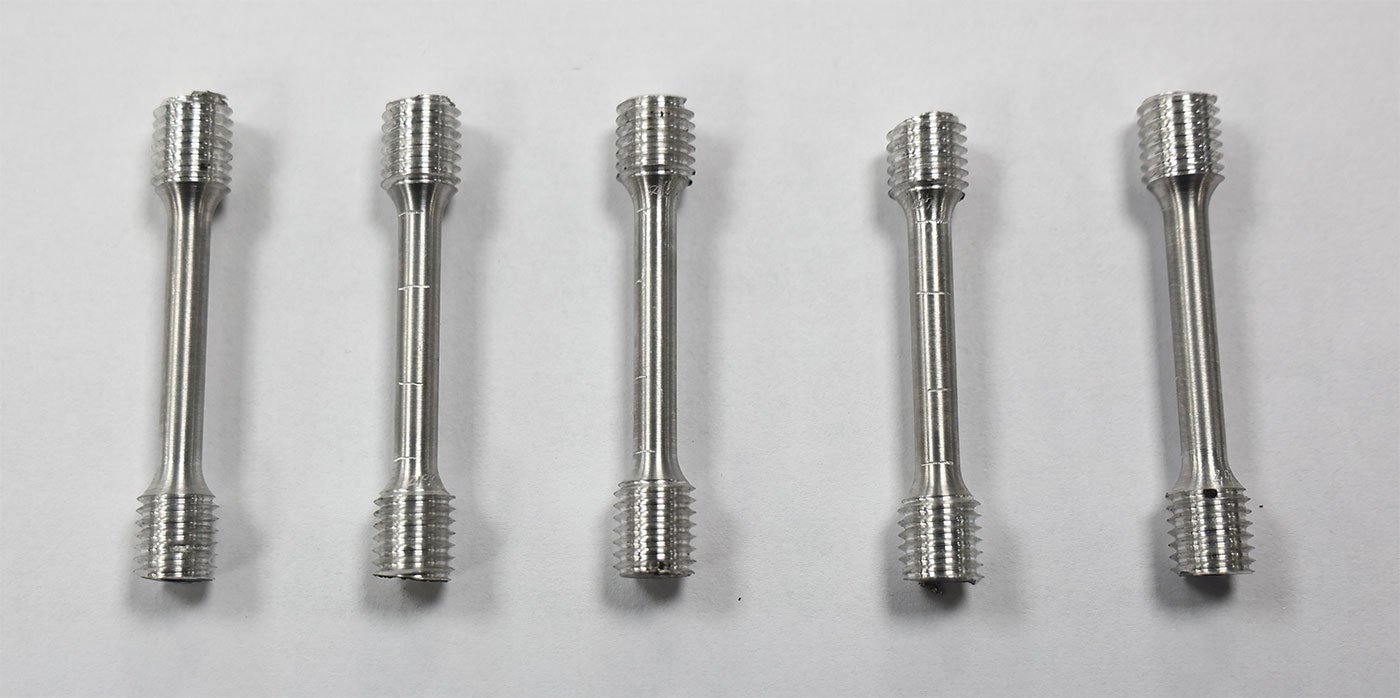
CNC-machined fatigue specimens with threaded ends
Industry Applications
Engineering Industries We Serve
Oil & Gas
Pipeline & Sour Service
Pipeline CTOD to BS 7448-2 and ISO 15653. Sour-service fracture toughness (NACE conditions). Weld CTOD for girth weld and repair weld qualification. HIC evaluation with fracture mechanics input.
Aerospace & Defence
Structural Life & Certification
KIC for Ti alloys (B909), Al alloys (B645), Ni superalloys. LCF for rotating engine components. Creep and stress rupture for turbine disc and blade materials. da/dN for damage-tolerant design.
Power & Energy
Boiler, Turbine & Pressure Vessels
Creep and stress rupture for P91, P92, P22 boiler tube materials. Larson-Miller analysis. Stress relaxation for high-temperature bolting. Remaining life assessment data. Creep crack growth for power plant piping.
Automotive
Drivetrain, Suspension & Structures
HCF for suspension arms, anti-roll bars, and spring steels. Rotating bending endurance for axle shafts. Torsional fatigue for drivetrain components. da/dN for crash-rate fracture mechanics assessment.
Marine & Offshore
Offshore Structures & Sub-Zero Integrity
CTOD for offshore structural steels and mooring chain steels. Sub-zero Charpy with DBTT curve. Weld fracture toughness for offshore weld procedures. Corrosion fatigue for subsea and splash zone components.
Nuclear
Fracture Toughness & Irradiation
KIC per B909 for zirconium and titanium alloys. Creep per ASTM E139. Fracture toughness at irradiation-relevant temperatures. PNAE G-10-032 weld qualification testing on request.
Why Microlab
Capabilities That Set Us Apart
First Commercial Fracture Mechanics Lab in South India
KIC, JIC, CTOD, and da/dN performed commercially since our founding. Not a new addition — our core competency from day one.
20+ Creep Machines — Largest Private-Sector Capacity
Individual furnace per station. Triple-zone temperature control. Continuous load and displacement logging. Run long-duration stress rupture campaigns without queue times.
In-House Specimen Preparation
CNC turning, VMC milling, and EDM wire-cut on-site. CT, SEB, DCT, dog-bone, creep specimens — all machined and verified in-house. No custody gaps, no outsourcing.
Pre-Cracking to ASTM Specification
Fatigue pre-cracking per E399/E647 requirements performed on our own servo-electric systems. Crack length verified optically on both specimen faces prior to fracture testing.
ISO 17025:2017 Qualit System
Dedicated testing for fracture toughness, fatigue, and creep testing parameters. Reports come with complete raw data and are accepted by regulators, OEMs, and certification bodies worldwide.
Engineers, Not Just Operators
Every fracture mechanics and creep result is reviewed by an engineer before issue. We flag validity failures, outliers, and anomalies — and explain what they mean for your component.
Test Window & Equipment Envelope
| Parameter | Capability | Notes |
|---|---|---|
| Fatigue Load Capacity | 1 kN to 250 kN servo-hydraulic | Multiple frames: 10, 50, 100, 250 kN |
| Frequency Range | 0.01 Hz to 50 Hz (servo-hydraulic); up to 100 Hz (resonance) | Waveform: sinusoidal, triangular, trapezoidal |
| R-Ratio | -1 to 0.5+ (fully reversed to tension-tension) | Custom R-ratios per client specification |
| Temperature Range | -70 °C to 1000 °C (with furnace/chamber) | High-temp extensometry available |
| Crack Monitoring | COD gauge, potential drop (DCPD), compliance method | Real-time crack length measurement |
| Specimen Geometry | CT, SEN(B), C(T), round bar, flat dog-bone, hourglass | CNC machining in-house per ASTM/ISO geometry |
| Creep Frames | Multiple dead-weight creep frames, up to 1200 °C | Constant load, multi-station, individual furnace control |
| Strain Control (LCF) | Axial extensometer, strain range 0.1% to 5%+ | Closed-loop strain control per ASTM E606 |
Choosing the Right Test Method
Common decision points for fatigue, fracture, and creep characterisation
KIC vs JIC vs CTOD
Fracture toughness — which parameter?
KIC (ASTM E399) for linear-elastic, plane-strain conditions — high-strength alloys, thick sections. JIC (ASTM E1820) when plasticity is significant — lower-strength steels, thinner sections. CTOD (BS 7448 / ISO 12135) widely used in oil & gas and structural codes, especially for weld qualification.
ASTM E399 · E1820 · BS 7448 · ISO 12135
HCF vs LCF
High-cycle vs low-cycle fatigue
HCF (ASTM E466): stress-controlled, >10⁴ cycles, S-N curve generation — rotating machinery, vibration, resonance. LCF (ASTM E606): strain-controlled, <10⁴ cycles, hysteresis loops — thermal cycling, start-stop, pressure cycling. Choice depends on service loading regime.
ASTM E466 · E606 · ISO 1099 · ISO 12106
da/dN vs S-N Curve
Crack growth vs total life
S-N testing gives total fatigue life (initiation + propagation) — used for design allowables. da/dN (ASTM E647) measures crack growth rate as a function of stress intensity — used for damage-tolerance analysis and inspection interval planning.
ASTM E647 · E466 · E606
Creep vs Stress Rupture
Deformation vs time-to-failure
Creep testing (ASTM E139) measures strain vs time at constant load and temperature — provides minimum creep rate and creep curves for design. Stress rupture testing determines time-to-failure — provides rupture life data for life prediction models (Larson-Miller, Monkman-Grant).
ASTM E139 · ISO 204
Data Deliverables
Fatigue (S-N / LCF)
S-N curves with statistical analysis, strain-life curves, hysteresis loops, cyclic stress-strain response, fatigue strength at specified life (e.g., 10⁷ cycles), run-out data, specimen fracture location documentation.
Crack Growth (da/dN)
Crack length vs cycles (a-N) data, da/dN vs ΔK plots, Paris law constants (C, m), threshold stress intensity (ΔKth), crack growth curves per environment/temperature, fractographic documentation of crack path.
Fracture Toughness
KIC / KQ values with validity assessment, J-R curves, CTOD values, load-displacement records, specimen dimensions and pre-crack measurements, compliance with size requirements, fractographic images.
Creep & Stress Rupture
Creep curves (strain vs time), minimum creep rate, time to specified strain levels (0.1%, 0.2%, 0.5%, 1%), rupture life, elongation and reduction of area at fracture, Larson-Miller parameter data.
Industry Applications
Aerospace & Defence
- Damage-tolerance crack growth data (da/dN) for airframe structural components
- Fracture toughness (KIC) qualification of high-strength aluminium and titanium alloys
- HCF validation of turbine blades, landing gear, and fastener systems
- Creep and stress-rupture characterisation for turbine disc and blade superalloys
ASTM E647 · E399 · E466 · E139 · AMS · MMPDS
Oil & Gas
- CTOD qualification for pipeline girth welds and riser systems (BS 7448, DNV)
- Corrosion-fatigue testing in sour/marine environments
- Creep assessment for high-temperature refinery piping and reactor vessels
- Fracture mechanics data for fitness-for-service assessments (API 579, BS 7910)
BS 7448 · ASTM E1820 · E647 · E139 · API 579 · DNV-OS-F101
Power & Energy
- Creep life assessment for boiler tubes, steam headers, and turbine casings
- LCF characterisation for components subject to thermal transients (start-stop cycles)
- Fracture toughness data for reactor pressure vessel steels
- Fatigue design curves for wind turbine gearbox and drivetrain components
ASTM E139 · E606 · E1820 · IBR · ASME Section III
Automotive
- HCF endurance validation of suspension springs, connecting rods, and crankshafts
- LCF characterisation for engine block and cylinder head materials under thermal cycling
- S-N curve generation for welded automotive structural joints
- Component fatigue testing under simulated road-load spectra
ASTM E466 · E606 · SAE J1099 · OEM specifications
3–5 Days
Standard Turnaround including machining
Machining
Reliable notch preparation & finishing
ISO 17025:2017
Reporting Practices
Related Services
Metals Testing
Mechanical, chemical, and metallographic testing of ferrous and non-ferrous metals
FE-SEM / EDS / EBSD
Nanometre-resolution imaging, elemental mapping, and crystallographic analysis
Structural Testing
Component endurance, durability, vibration, and IP rating validation
Metallography & Failure Analysis
Microstructure examination, root cause failure analysis, and fractography