
- Home
- / Services
- / Structural Testing & Endurance
Structural & Endurance Testing
Private-Sector Alternative
to Government Test Facilities
Multi-channel servo-hydraulic endurance, vibration, thermal, IP rating, and full-vehicle
component durability testing — under one roof.
±400 kN
Max. Static Force
8 Channels
Real-Time Controller
8000×6000 mm
Test Platform
0.001 – 100 Hz
Frequency Range
IP69K
Ingress Rating Capable
ISO/IEC 17025:2017
Validated and Traceable
Servo-Hydraulic Endurance Rig
Dual-Channel Gantry-Frame — Full Specifications
A production-grade structural endurance facility designed for automotive component validation. The same class of equipment used by Tier-1 OEM suppliers and independent accredited labs globally.
| Parameter | Specification |
|---|---|
| Configuration | Dual-channel servo-hydraulic, gantry-frame |
| Max. Static Force | >±400 kN per channel |
| Max. Dynamic Force | >±300 kN per channel |
| Displacement Stroke | ±125 mm (250 mm total) |
| Test Frequency | 0.001 – 100 Hz |
| Control Modes | Load, displacement, deformation |
| Platform | 8000 × 6000 mm (HT250 grade cast iron) |
| Gantry Frame | 400 kN, height adjustable (100 mm steps) |
| Hydraulic Station | >300 L/min flow rate |
| Controller | Up to 8 channels, real-time control |
| Sensors | Spoke-type load cell (±400 kN) + LVDT |
| Waveform | Sine, triangle, square, random, user-defined |
| Data Acquisition | Continuous, all channels, auto shut-off |
What the Specs Mean in Practice
Platform Size
An 8 m × 6 m HT250 cast iron bed accommodates full axle assemblies, sub-frames, and multi-point fixture rigs simultaneously — no reconfiguration between tests.
Force Capacity
±400 kN static per channel handles passenger car AND heavy commercial vehicle (HCV) components under the same setup without capacity limitations.
8-Channel Controller
Multi-point loading replicates real-world road load data (RLD) — simultaneous vertical, lateral, and longitudinal inputs across the component in a single test run.
Waveform Flexibility
Sine, random, user-defined, and mixed profiles — supports OEM-specific load spectra, PSD profiles, and custom fatigue sequences without additional setup.
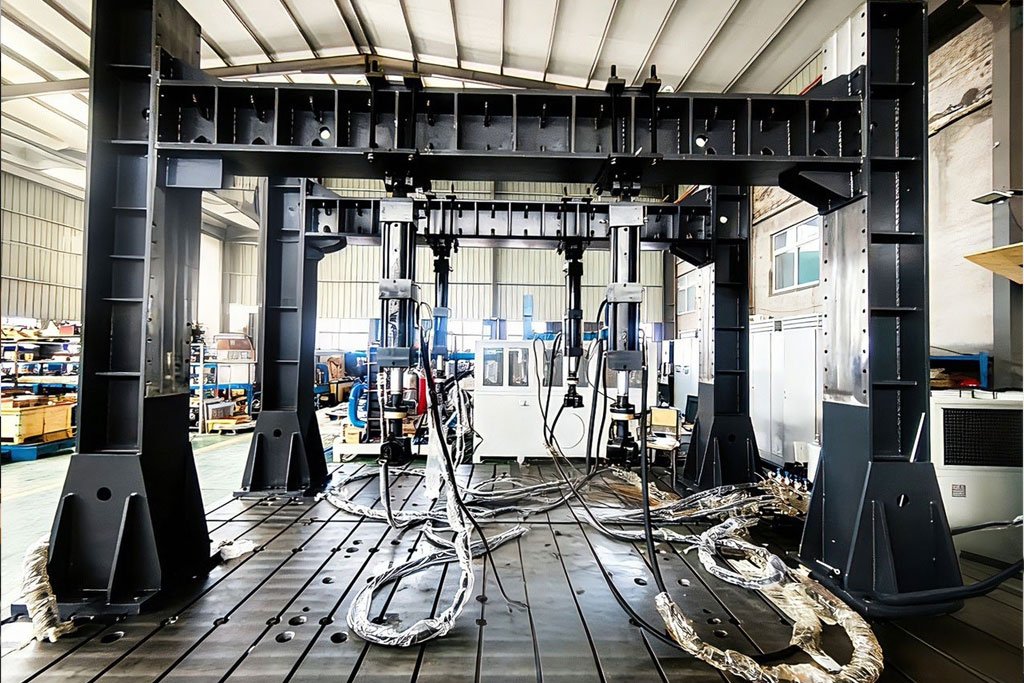
Structural endurance test frame — multi-actuator gantry
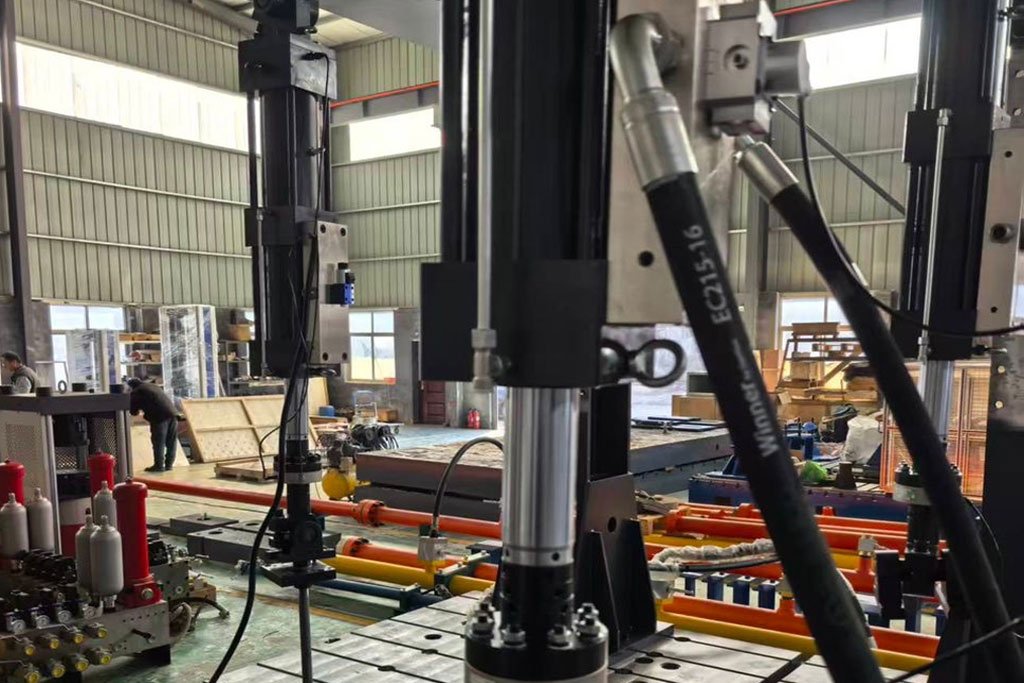
Hydraulic actuators on T-slot floor plate
Automotive Component Endurance
Drive Axle to Steering Column. We Test the Full Powertrain and Chassis.
All tests performed to OEM specifications, applicable IS/ISO/QC-T/SAE standards, and customer-supplied load spectra. Validated test reports issued for all parameters following the customer specification.
| Test | Application / Component | Standards / Method |
|---|---|---|
| Drive Axle Bending Fatigue | Axle housing endurance under bending loads | QC-T533-1999 |
| Front Suspension Fatigue | Upper/lower control arms, steering knuckle, ball joint | OEM specs, ISO 5721 |
| Rear Suspension Fatigue | Leaf spring, trailing arm, panhard rod | OEM specs |
| Structural Endurance | Brackets, sub-frames, cross-members, body mounts | OEM specs |
| Leaf Spring Position Loading | Spring pack fatigue under vertical & position loads | IS 1135, OEM |
| Wheel End Loading | Hub, bearing assembly, spindle, knuckle | SAE J328 |
| Seat Frame Fatigue | Seat structure endurance, recliner, slide rail | ECE R17, FMVSS 207 |
| Pedal Fatigue | Brake pedal, clutch pedal, accelerator pedal assembly | OEM specs |
| Steering Column Fatigue | Column assembly, mounting bracket, collapsible section | OEM specs |
| Exhaust System Durability | Muffler, exhaust pipe, flexible joint, hanger bracket | OEM specs |
OEM Load Spectra: We accept customer-provided load-time histories and PSD profiles. Tests can be configured to replicate proving ground events, road load data (RLD), or mission profile duty cycles specified by the OEM or Tier-1 customer.
Vibration Testing
Sinusoidal, Random, Shock, and Combined Vibration + Thermal
Full vibration qualification to IEC 60068 series for automotive, electronics, and industrial components. Sine, random, SoR, and mechanical shock profiles.
| Test | Standards | Details |
|---|---|---|
| Sinusoidal Vibration | IEC 60068-2-6 | Frequency sweep, resonance search, resonance dwell — detect structural resonances and fatigue failure modes |
| Random Vibration | IEC 60068-2-64 | PSD profile (Power Spectral Density), broadband excitation — simulates real-world road, transport, and operational environments |
| Sine-on-Random (SoR) | — | Combined narrowband sinusoidal tones superimposed on random broadband — realistic powertrain and rotating machinery profiles |
| Mechanical Shock | IEC 60068-2-27 | Half-sine, trapezoidal, sawtooth pulses — simulates handling drops, road impacts, pothole events |
| Bump Testing | IEC 60068-2-29 | Repetitive mechanical shock testing — cumulative damage assessment over thousands of bump cycles |
| Combined Vibration + Thermal | — | Simultaneous vibration excitation and controlled temperature exposure — accelerated life testing under concurrent stress environments |
Environmental & Reliability Testing
IP69K. Thermal Shock. Salt Spray. Flammability. Under One Roof.
Complete environmental qualification from IP ingress rating to thermal cycling to corrosion. All tests to IEC, ASTM, ISO, and FMVSS standards.
| Test | Standards | Details |
|---|---|---|
| IP Rating — Dust Ingress | IEC 60529 | IP5X (dust protected), IP6X (dust tight) — fine dust chamber testing for enclosures and connectors |
| IP Rating — Water Ingress | IEC 60529 | IPX1 through IPX9K — full range from drip protection to high-pressure, high-temperature jet wash (80°C, 80–100 bar) |
| Thermal Shock | IEC 60068-2-14 | −40°C to +150°C rapid cycling — detects thermo-mechanical fatigue, delamination, solder joint failure |
| Humidity Chamber | IEC 60068-2-78 | 85°C / 85% RH (steady state), cyclic humidity (IEC 60068-2-30) — corrosion, swelling, electrical insulation degradation |
| Salt Spray (Corrosion) | ASTM B117 | Neutral salt spray (NSS) — corrosion resistance of coatings, platings, and base materials |
| Flammability | UL 94, FMVSS 302, ISO 3795 | Vertical burn (UL 94 V-0/V-1/V-2/HB), horizontal burn rate — automotive interior and industrial component fire compliance |
| Crush / Deformation | — | Static and dynamic crush testing — energy absorption, intrusion limits, structural integrity under compressive loading |
| Temperature Cycling | IEC 60068-2-14 | Extended temperature range, multiple cycles — qualification of electronics assemblies, seals, adhesive bonds, and composite joints |
Why Microlab
ARAI-Equivalent Capability. Private-Sector Speed and Pricing.
India’s government labs are benchmark references — but queue times and inflexible schedules drive engineering teams toward private accredited facilities. Microlab closes that gap.
±400 kN Capacity
Handles both passenger car and heavy commercial vehicle components without force-range limitations. No need to split testing across multiple labs.
8-Channel Controller
Multi-point simultaneous loading replicates real-world road load data — vertical, lateral, and longitudinal inputs in a single test event. Not sequential, not estimated.
8000 × 6000 mm Platform
Full sub-assemblies — complete axle, suspension corner, or seat module — fit on the HT250 cast iron bed without spatial constraints or fixture compromises.
Combined Environment
Vibration and thermal and humidity simultaneously in a single test run. Accelerated life testing that reflects real operating conditions, not isolated stress modes.
IP69K Capable
Highest standard of water ingress protection testing — 80°C water at 80–100 bar. Critical for EV connectors, underbody electronics, and off-highway components.
Private-Sector Pricing
Test results without government lab overhead. Transparent quotation, confirmed scope before testing begins, no hidden charges on report issuance.
Fast Turnaround
No government queue. Test scheduling within days, not months. Urgent project support available. Direct engineer-to-engineer communication on test configuration.
Industries Served
From Passenger Cars to Defence Vehicles
Our structural testing facility serves any sector that requires structural durability, endurance, or environmental qualification of mechanical components and assemblies.
Automotive OEM & Tier-1
Commercial Vehicles
Two-Wheeler
Railways
Defence Vehicles
EV / Electric Mobility
Agricultural Equipment
Industrial Equipment
Defining Your Test Program
Key variables we work through before testing begins
Component Type
Automotive assemblies (suspension, chassis, brackets), industrial equipment (frames, housings, actuators), consumer products (furniture, appliances), infrastructure components (poles, beams, connections).
Load Path & Duty Cycle
Static (proof load, ultimate), cyclic (constant amplitude, variable amplitude, spectrum loading), combined (tension + bending, axial + torsion), with defined load levels and cycle targets.
Fixture Design
In-house fixture engineering ensures load application replicates real-world constraints. Custom jigs, grips, loading shoes, and reaction frames designed per component geometry.
Failure Criterion
Complete fracture, crack initiation (visual or instrumented), stiffness degradation (%), permanent deformation limit, functional loss (e.g., seal failure, bearing play). Defined before test start.
Data Acquisition
Multi-channel DAQ: load, displacement, strain gauges, accelerometers, temperature, cycle count. Real-time monitoring with peak/valley capture and time-history recording.
Correlation Studies
Comparison between FEA predictions and physical test results. Strain gauge rosettes at critical locations, displacement measurement via LVDT, and correlation reporting for design validation.
Test Rig Specifications
Servo-hydraulic and electro-mechanical testing infrastructure
| Rig / System | Load Capacity | Stroke | Frequency | Control Modes |
|---|---|---|---|---|
| Multi-Actuator Endurance Bed | Multiple channels, up to 50 kN per actuator | ±150 mm | 0.01 – 30 Hz | Load, displacement, strain |
| Servo-Hydraulic UTM (100 kN) | 100 kN static & dynamic | ±75 mm | 0.01 – 50 Hz | Load, displacement, strain |
| Servo-Hydraulic UTM (250 kN) | 250 kN static & dynamic | ±75 mm | 0.01 – 30 Hz | Load, displacement |
| Electrodynamic Shaker | Vibration testing per ISO 16750 | N/A | 5 – 2000 Hz | Sine, random, shock |
| IP Rating Chamber | Water ingress testing | N/A | N/A | IP54 through IP67 |
Structural vs. Product Validation vs. Environmental
Choosing the right test program for your component
Structural Testing
This page
Applies mechanical loads (static, cyclic, multi-axis) to components or assemblies to validate structural integrity, endurance life, and load-carrying capacity. Focus: will it break under service loads?
Corrosion vs. Environmental Testing
Full qualification programs
Manages the complete qualification program: DV (design validation), PV (production validation), PPAP documentation. May include structural tests as part of a broader test matrix with dimensional, environmental, and functional tests.
Metallography vs. SEM/EBSD
Exposure-based qualification
Subjects products to environmental stresses: temperature cycling, humidity, UV, salt spray, vibration. Focus: will it survive the environment? — not the structural load. Often combined with structural testing for comprehensive qualification.
5–7 Days
Standard Turnaround. Get a slot in advance
Fixtures
In-house development
ISO 17025
Reports
Related Services
Product Validation
OEM qualification, environmental endurance, vibration, and IP rating testing
Fatigue & Fracture
KIC, JIC, CTOD, da/dN, LCF/HCF fatigue and creep rupture testing
Environmental Testing
Xenon arc, UV weathering, thermal shock, and humidity cycling
Metals Testing
Mechanical, chemical, and metallographic testing of ferrous and non-ferrous metals
Ready to Validate Your Component?
Share your test specification — OEM drawing, load spectrum, or standard reference. We’ll confirm scope, fixture approach, and turnaround before you send the sample.