
- Home
- / Services
- / Composites Testing
CFRP. GFRP. Aramid.
Hybrid. — Tested to
Aerospace and
Automotive Standards.
Complete mechanical, thermal, and microstructural characterization of fiber-reinforced polymer composites with video extensometer and SEM interface analysis.
Aerospace Materials Testing
NADCAP Pursuit. NABL Accredited.
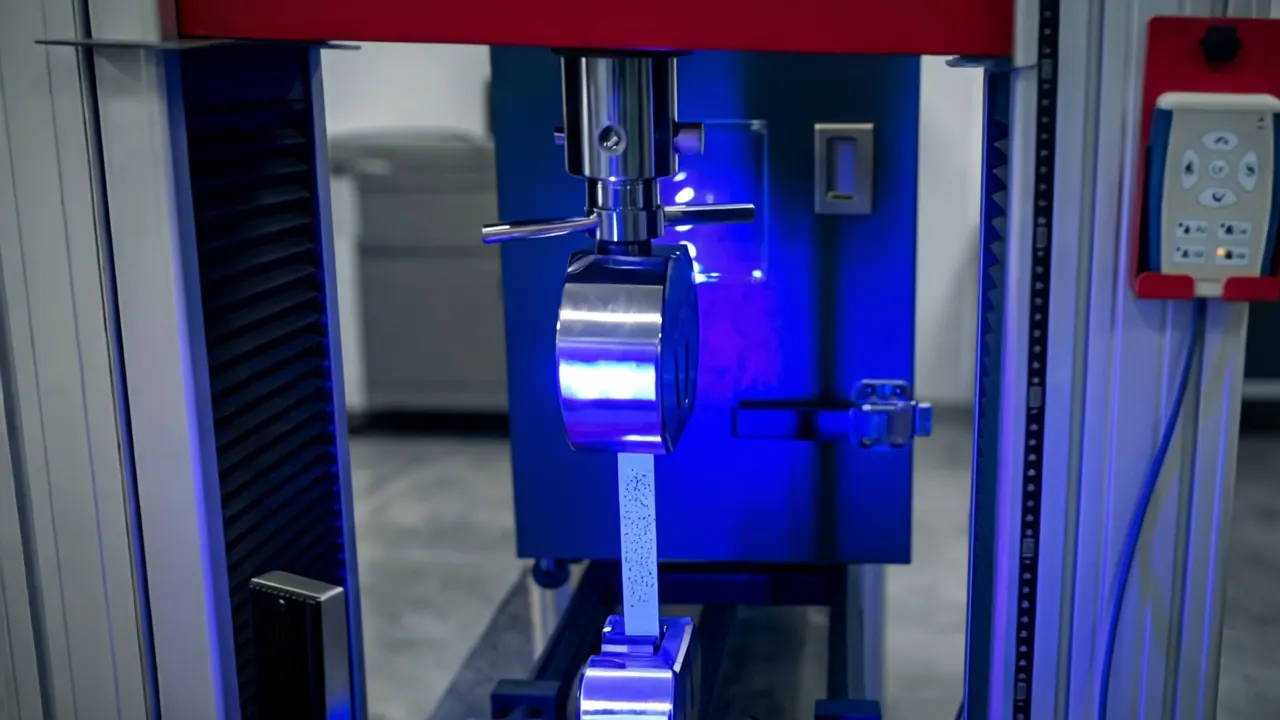
Aerospace Materials Testing
NADCAP Pursuit. NABL Accredited. Full ASTM and ISO mechanical, thermal, and microstructural characterization.
Mechanical Testing
From Tensile to CAI. Laminate to Joint.
Full ASTM and ISO mechanical characterization of composite laminates — including open hole, bearing, fracture toughness, fatigue, and compression after impact. Video extensometer used throughout for non-contact, non-intrusive strain measurement.
| Test | Standards | Details |
|---|---|---|
| Tensile Properties | ASTM D3039, ISO 527-4/5 | Modulus, strength, Poisson's ratio, video extensometer |
| Compressive Properties | ASTM D3410, D6641 (CLC), ISO 14126 | In-plane compression, combined loading compression (CLC fixture) |
| Flexural Properties | ASTM D790, D7264, ISO 14125 | 3-point and 4-point bending configurations |
| In-Plane Shear | ASTM D3518, D7078 (V-notch), ISO 14129 | ±45° tension method, V-notch rail shear fixture |
| Interlaminar Shear Strength (ILSS) | ASTM D2344, ISO 14130 | Short beam shear — ply-by-ply dominated failure |
| Open Hole Tension (OHT) | ASTM D5766 | Notch sensitivity of laminates |
| Open Hole Compression (OHC) | ASTM D6484 | Compressive strength after drilling |
| Filled Hole Tension / Compression | ASTM D6742, D6743 | Bolt-loaded hole — fastener interaction effects |
| Bearing Strength | ASTM D5961 | Single shear and double shear bolt bearing |
| Impact — Drop Weight (BVID) | ASTM D7136 | Barely visible impact damage (BVID) characterization |
| Compression After Impact (CAI) | ASTM D7137 | Residual compressive strength post-impact |
| Interlaminar Fracture Toughness GIC | ASTM D5528 | Mode I — Double Cantilever Beam (DCB) |
| Interlaminar Fracture Toughness GIIC | ASTM D7905 | Mode II — End Notch Flexure (ENF) |
| Fatigue | ASTM D3479 | Tension-tension fatigue, S-N curves, stiffness degradation |
| Hardness (Barcol) | ASTM D2583 | Surface hardness of cured laminates |
Video extensometer for all strain-critical tests: Non-contact, non-intrusive optical extensometry eliminates tab slip errors and grip-induced artefacts. Poisson’s ratio, biaxial strain, and full axial strain measurement without bonded gauges — critical for low-fiber-volume and thin-ply laminates.
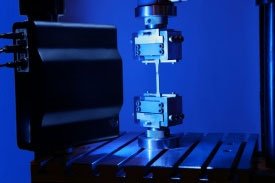
Video extensometer — non-contact optical strain measurement on a CFRP tensile specimen
Wide-temperature mechanical testing — −70°C to +180°C: Our environmental chambers enable mechanical testing across a wide temperature range from −70°C to +180°C, simulating extreme service conditions for aerospace, automotive, and industrial composite applications.
Thermal & Physical Testing
Tg by DSC and DMA. Fiber Volume by Burn-off and Acid Digestion.
| Test | Standards | Details |
|---|---|---|
| Glass Transition Temperature (Tg) | ASTM D7028, E1356 (DSC), E1640 (DMA) | DSC onset/midpoint method and DMA tan δ peak method |
| DSC — Differential Scanning Calorimetry | ASTM D3418 | Degree of cure, crystallinity, residual enthalpy, thermal transitions |
| TGA — Thermogravimetric Analysis | ASTM E1131 | Thermal decomposition, filler/fiber content verification |
| DMA — Dynamic Mechanical Analysis | ASTM D7028, E1640 | Storage modulus (E'), loss modulus (E''), tan δ, Tg |
| Coefficient of Thermal Expansion (CTE) | ASTM E831 (TMA) | In-plane and through-thickness CTE by thermomechanical analysis |
| Fiber Volume Fraction | ASTM D2584, D3171 | Burn-off (ignition loss) and acid digestion methods |
| Void Content | ASTM D2734 | Calculated from density + fiber and resin content |
| Density | ASTM D792 | Water displacement / Archimedes method |
| Water Absorption / Moisture Uptake | ASTM D5229 | Equilibrium moisture content — Procedures A, B, C |
| Flammability | FAR 25.853, UL 94 | Aerospace cabin material flammability and general flammability |
| Smoke Density | ASTM E662 | NBS smoke chamber — specific optical density |
Microstructural Analysis
Interface. Void. Delamination. Fractography.
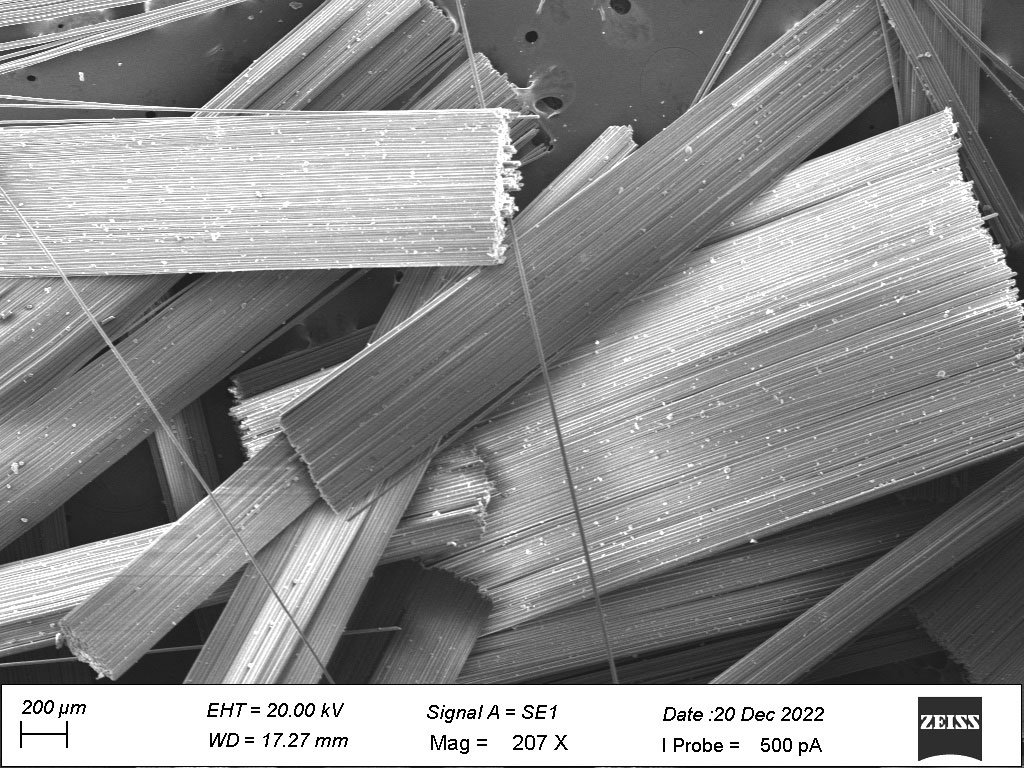
SEM micrograph — fiber bundle morphology at 207x magnification
FE-SEM — Fiber-Matrix Interface Analysis
High-resolution imaging of fiber-matrix debonding, delamination fracture surfaces, and failure mode identification. EDS for contamination or surface treatment analysis. Fractography to distinguish tensile fiber failure, compressive kinking, and interfacial shear failure.
- Fiber-matrix interface
- Delamination surfaces
- Failure mode ID
Cross-Section Microscopy
Polished cross-sections imaged under optical and scanning electron microscopy. Ply layup verification, void and porosity mapping, fiber distribution uniformity, resin-rich zone identification, and inter-ply resin thickness measurement.
- Ply layup verification
- Void mapping
- Fiber distribution
FTIR Spectroscopy
Resin system identification (epoxy, vinyl ester, polyester, BMI, PEEK), degree of cure monitoring by tracking residual reactive group absorption bands, and contamination analysis on bonding surfaces or fiber sizings. ATR mode for surface-specific analysis.
- Resin identification
- Cure monitoring
- Contamination analysis
Micro-CT — 3D Void and Damage Assessment
Non-destructive 3D tomographic imaging for internal void/porosity mapping, impact damage assessment (BVID internal crack network), delamination extent, and fiber waviness. Quantitative void volume fraction and spatial distribution. Pre- and post-test scanning for damage progression studies.
- 3D void mapping
- Internal damage
- Non-destructive
Materials Tested
Across the Composite Material Spectrum
From aerospace-grade prepreg CFRP to civil infrastructure FRP rebar — specimen preparation in-house from panels, structures, and cut-outs.
CFRP — Carbon Fiber Reinforced Polymer
Unidirectional (UD), woven fabric, non-crimp fabric (NCF), and prepreg systems. Thermoset (epoxy, bismaleimide) and thermoplastic (PEEK, PEKK) matrices.
GFRP — Glass Fiber Reinforced Polymer
E-glass, S-glass, woven and UD configurations, chopped strand mat (CSM) laminates. Polyester, vinyl ester, and epoxy matrices.
Aramid (Kevlar) Composites
Ballistic-grade and structural aramid laminates. Woven Kevlar-29 and Kevlar-49. Interface-sensitive testing with appropriate fixture selection.
Hybrid Composites
Carbon-glass hybrid laminates for stiffness-cost optimisation. Carbon-aramid for ballistic-structural combined performance. Interply and intraply hybrid architectures.
Natural Fiber Composites
Jute, hemp, and flax fiber composites for automotive interior applications. Bio-resin systems. Comparative benchmarking against GFRP properties.
Sandwich Panels
Honeycomb core (Nomex, aluminium), structural foam core (PVC, PMI), and balsa core sandwich structures. Flatwise tension, flatwise compression, and climbing drum peel.
SMC / BMC
Sheet Molding Compound and Bulk Molding Compound for automotive body panels and structural components. Mechanical, thermal, and surface quality characterization.
FRP Rebar & Pultruded Profiles
GFRP and CFRP rebar for civil and infrastructure applications. Pultruded I-sections, channels, and angles. Tensile, flexural, bearing, and bond-to-concrete testing.
Industry Applications
Where These Tests Are Applied
From Nadcap laminate qualification to wind blade fatigue — aligned to the test requirements of each end-use sector.
Aerospace
Laminate qualification, CAI, OHT/OHC, GIC/GIIC per Nadcap/NCAMP. Allowables generation for structural databases. Prepreg qualification, process variation studies, and repair certification testing.
Automotive
SMC/BMC for body panels, CFRP for lightweighting programmes, and NVH composite components. OEM-specific qualification protocols and mass production variability monitoring.
Wind Energy
Blade materials: tension-tension fatigue per ASTM D3479, GIC and ILSS for adhesive bondlines, moisture conditioning per IEC 62817, and accelerated UV/hygrothermal aging of spar cap GFRP.
Marine
Hull laminate mechanical characterization, deck sandwich panel testing, long-term water absorption (ASTM D5229 Procedure C), and post-conditioning strength retention for offshore FRP structures.
Defence
Ballistic panel base laminate testing, structural armor CFRP/aramid hybrid qualification, blast-resistant composite sandwich structures. Environmental durability under tropical and desert conditioning.
Sporting Goods
Bicycle frame CFRP tube testing, racquet shaft flexural stiffness, and helmet shell impact and compression. Consumer product durability and certification support.
Also Available
Extended Composites Testing Services
Accelerated Aging of Composites
UV weathering (Xenon arc, UVA-340), hygrothermal conditioning, thermal cycling, and moisture-conditioned mechanical testing. Pre- and post-aging property comparison and retention factor calculation.
Environmental Stress Cracking
Chemical resistance evaluation in solvents, fuels, acids, and alkalis. Sustained load (creep) under chemical exposure. Matrix-dominated property degradation under combined moisture and stress.
Joint Testing — Bonded & Bolted
Adhesively bonded lap shear (ASTM D1002, D3165), climbing drum peel (D1781), double cantilever beam for adhesive GIC. Bolted joint bearing, bolt-pull-through, and multi-fastener patterns.
Custom OEM Protocols
Test method development and execution per OEM-specific test specifications. Experience with Airbus, Boeing, automotive OEM, and defence DRDO material qualification protocols. Test plan support and data reduction in OEM formats.
Failure Analysis with SEM Fractography
Root cause failure analysis of composite structures and components. SEM fractography, cross-section microscopy, micro-CT, and mechanical verification. Written RCFA report with actionable recommendations.
In-House Specimen Machining
CNC machining of composite coupons from panels, plates, and cut-outs to ASTM/ISO geometry. Water-jet and diamond-wheel cutting to avoid delamination. No custody break between panel receipt and testing.
Laminate Architecture & Test Selection
Testing depends on your composite construction
Unidirectional (UD) Laminates
Prepreg tape, tow-placed
Longitudinal & transverse tensile, compression, in-plane shear (±45°), ILSS, open-hole tension/compression. Fiber-dominated properties for primary structural allowables.
ASTM D3039 · D3410 · D3518 · D2344 · D5766 · D6484
Woven / Fabric Laminates
Woven prepreg, hand layup
Tensile, compression, flexure, bearing strength, CAI (compression after impact). Balanced/quasi-isotropic layup testing with notch sensitivity assessment.
ASTM D3039 · D3410 · D3518 · D2344 · D5766 · D6484
Infusion / RTM Parts
VARTM, RTM, wet layup
Fibre volume fraction, void content, mechanical properties, cure verification (DSC). Process-sensitive parameters that validate manufacturing quality.
ASTM D3171 · D2734 · D3418 · Mechanical per above
Sandwich Panels
Honeycomb, foam, balsa core
Flatwise tension, edgewise compression, flexure, core shear, climbing drum peel. Core-facesheet bond integrity and panel-level structural performance.
ASTM C297 · C365 · C393 · D1781
Environmental Preconditioning Notes
- Hot/Wet conditioning: Specimens conditioned at 70 °C / 85% RH until equilibrium moisture content — typically 1000–2000 hours depending on thickness. Tested at elevated temperature (typically 70–120 °C).
- Cold/Dry (CTD): Tested at −55 °C or −54 °C after dry conditioning. Used for aerospace cold-temperature allowables.
- Room Temperature Dry (RTD): Baseline condition — as-fabricated, ambient stored specimens.
- Fluid immersion: Fuel, hydraulic fluid, de-icing fluid exposure per OEM specification before mechanical testing.
- Panel requirements: Supply cured panels (minimum 300 × 300 mm) or individual coupons machined per ASTM geometry. We handle tab bonding and machining in-house.
5–7 Days
Standard Turnaround
2–3 Days
Express Available
ISO 17025:2017
Reporting Practices
Related Services
Polymer Testing
Plastics, rubber, and foam testing including tensile, impact, HDT, MFI, and DSC
Structural Testing
Component endurance, durability, vibration, and IP rating validation
Environmental Testing
Xenon arc, UV weathering, thermal shock, and humidity cycling
FE-SEM / EDS / EBSD
Nanometre-resolution imaging, elemental mapping, and crystallographic analysis
Testing Aerospace-Grade Composites or Qualifying a New Laminate System?
Discuss your test matrix with our composites engineer. We’ll confirm scope, coupon geometry, conditioning requirements, and turnaround.